Permanent and Secretory Tissues Notes For B.sc 3rd Sem
1. Introduction
-
Plant tissues are groups of cells having a common origin and performing specific functions.
-
Broadly, plant tissues are of two types:
-
Meristematic Tissues – actively dividing cells.
-
Permanent Tissues – cells that have lost the power of division and are specialized in function.
-
-
In addition, plants have Secretory Tissues – responsible for secretion of useful or waste substances.
2. Permanent Tissues
-
Definition: These are tissues formed by the differentiation of meristematic cells. Once formed, they usually lose the ability to divide and perform permanent functions like storage, support, transport, photosynthesis, etc.
Types of Permanent Tissues:
-
Simple Permanent Tissues
-
Complex Permanent Tissues
-
Special / Secretory Tissues (discussed separately)
2.1 Simple Permanent Tissues
-
Composed of only one type of cell.
-
Functions: storage, support, photosynthesis, protection.
a) Parenchyma
-
Living cells, thin-walled, isodiametric.
-
Intercellular spaces present.
-
Found in cortex, pith, mesophyll, etc.
-
Functions:
-
Storage of food (e.g., starch in potato tuber)
-
Photosynthesis (chlorenchyma in leaves)
-
Buoyancy (aerenchyma in hydrophytes due to air spaces)
-
Wound healing and regeneration.
b) Collenchyma
-
Living cells with unevenly thickened cell walls (cellulose & pectin).
-
Usually located below the epidermis in dicot stems.
-
Provides flexible mechanical support.
-
Example: petioles of celery, sunflower stem.
c) Sclerenchyma
-
Dead cells with thick, lignified walls.
-
Two types:
-
Fibres: elongated, spindle-shaped cells, mechanical strength.
-
Sclereids (stone cells): short, irregular, very thick walls, found in seed coats, nutshells, gritty texture of guava/pear.
-
-
Function: rigidity, hardness, mechanical support.
(b) Complex tissue: Complex tissue is composed of more than one kind of cells. They are two types, namely Xylem tissue and Phloem tissue.
i. Xylem tissue: Xylem tissue consists of four types of cells, namely: Tracheids, Vessels or Trachaea, Xylem fibre and Xylem Parenchyma.
Tracheids: Cells are dead, long withtransverse ends, containing large vacuole. Cell walls are hard, strong. and lignified. Their main functions are to gIve mechanical strength and to supply water and dissolved minerals from root to the leaves.
Vessels or Trachaea: Cells are broadand short, placed end to end to form a continuous hollow tube. Water and waterdissolved minerals are conducted from root to leaf by these cells.
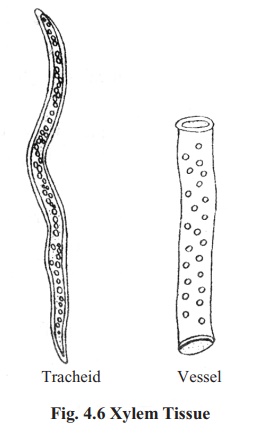
Xylem fibre: These are sclerenchymatouscells. Their main function is to give mechanical strength to the plant.
Xylem parenchyma: These areparenchymatous .cells. Functions of these cells are storage and conduction of food materials.
Functions of xylem tissue: Theirfunctions are to give mechanical strength to the plant body, conduction of water, minerals and food materials and storage of food.
ii. Phloem tissue: Phloem tissue consists offour types of cells, namely: sieve tubes, companion cells, phloem fibres and phloem parenchyma.
Sieve tube: These are elongate hollowcells placed end-to-end forming.
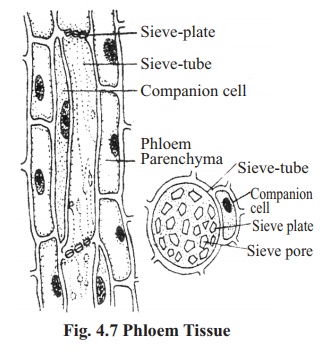
Division of Labour in Multicellular Plants a long tube. The partition walls between two adjacent sieve cells are perforated and known as sieve plate. In m4;iture sieve tube there is. no nucleus in the cell. Conduction of food, prepared in the leaves is its main function.
Companion cells: These are parenchymatous, narrow, elongated cells, andare closely associated with the sieve tube. They have dense cytoplasm and a large nucleus. Conduction with the sieve tube is done through the pores present on the walls of these cells. They help the sieve tubes in conduction of food materials.
Phloem fibre: These are Sclerenchymatous cells. They are also known as bast fibre. Its function is to give mechanical strength.
Phloem parenchyma: These are parenchymatous cells. They help in storageand conduction of food materials.
Function of Phloem tissue:
There main function is to conduct food materials, prepared in the leaves, to different parts of the plant.
They give mechanical strength to plant organ.
In case of necessity they store food materials.
Importance of Complex tissues:
In respect of physiological and economic aspects, complex tissues are of great importance.
Physiological importance:
Complex tissues perform the duty of conduction of raw food materials to leaves and prepared food materials to all the living cells.
Beside preparation of food, water is necessary for various reactions. This water is conducted from root to stem through the complex tissue named xylem.
Through xylem tissue dissolved minerals along with water also passes upwardly.
Water used in transpiration also moves to leaf through xylem tissue
Economic importance
The most important economic crop in Bangladesh is jute fiber. Jute fiber is the secondary phloem or bast fiber.
The wood we use, in the construction of houses, in making furniture, boat or musical instruments or as fuel, is the secondary xylem.
Secretory tissue: Secretoy tissues are those tissues, which secretsvarious liquids, Resins, gums, rubber etc. are collected from secretory tissues. They are of two types:
-


Comments
Post a Comment